
How Surgeons Stitch With Needles
Here is a quick story of threads and needles - how they evolved over the last three thousand two hundred years.


The English version of this topic is here
এই টপিকের বাংলা লিংকের জন্য এখানে ক্লিক করুন
Some of the stories in medical line are seriously weird. Many of our patients are curious and say, Doctor, show us how you stitch in the stomach!
So here is not only how we sew in our OT, but here is a quick story of threads and needles - how they evolved over the last three thousand two hundred years.
From needle- to thread, history-to fable, science and wonder - all in today’s video.
And finally, let me share personal experience: the choice of thread and needle in complex gynecological surgery is also a huge science. I will briefly tell you the strategy of avoiding suboptimum stitches in surgery.
🗿 History
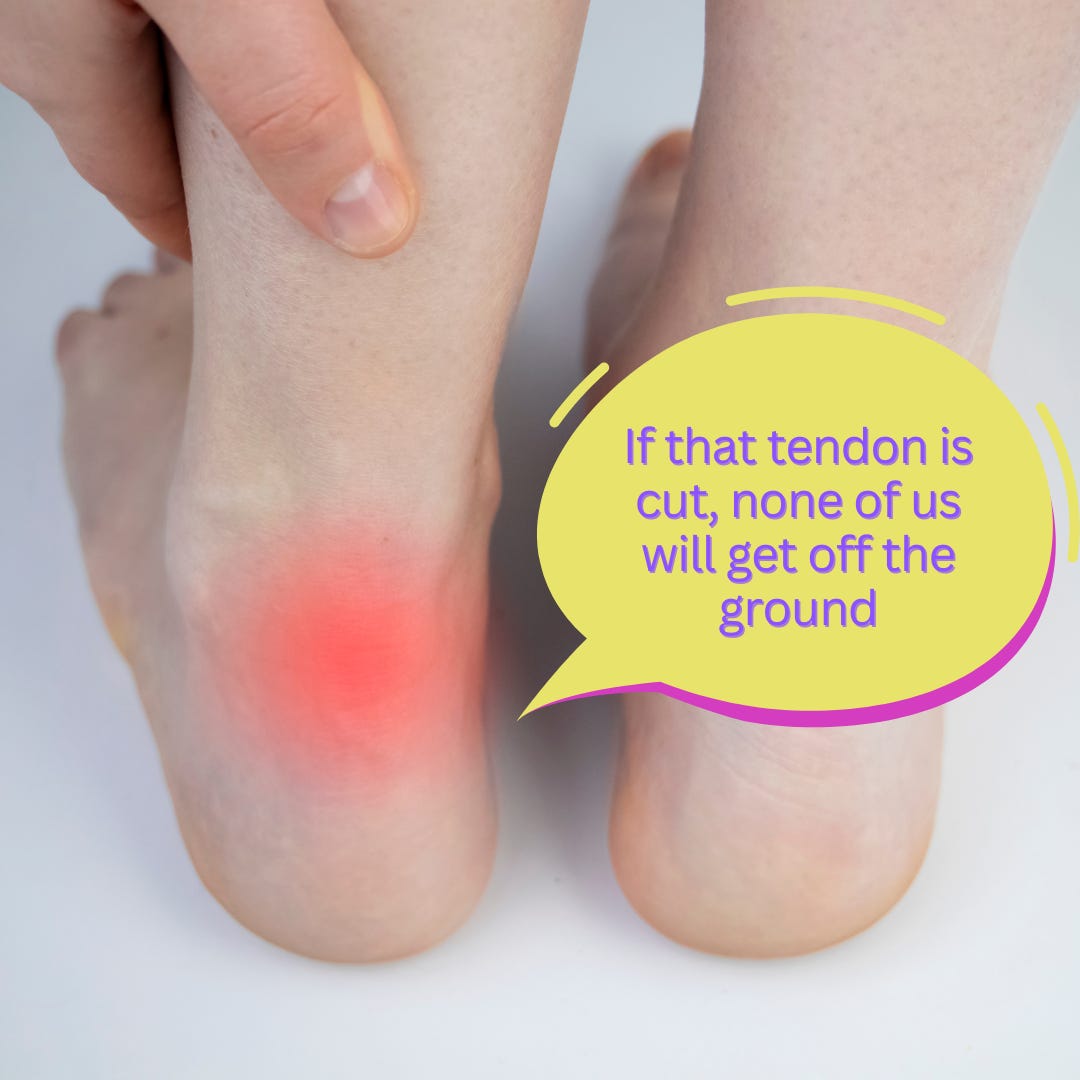
Two thousand years ago, The Colosseum of the Roman Empire entertained wealthy elite citizens. People would cheer as the gladiators fought fiercely. The aim was to injure the opponent. The tendon at the back of the heel was an easy target. If that tendon is cut, none of us will get off the ground. The name of this tendon is Achilles tendon.

In Greek mythology, Achilles, the son of Thetis, possessed enormous strength. He was defeated in battle after injuring the tendon in the back of his leg. The proverbial Achilles Heel. In gladiatorial combat, the enemy would aim to cut the Achilles tendon. That could be the end of his career.
👉🏾 A type of fiber obtained from the intestine of sheep was used to stitch this severed Achilles tendon. In the writings of Galen (131 to 211 AD) we find how gladiators were made war-fit again by sewing up their legs with this thread.
🧵 But how on earth people could even think it can be sewn?
In those days, the fiber obtained from sheep’s intestine was used in musical instruments like guitar or violin. The sound was melodious. This three-stringed violin was called Kit.
👉🏾 Rumor has it that once a celebrity gladiator’s severed tendon was desperately stitched together with a needle using an available violin string. (https://en.wikipedia.org/wiki/Catgut) This is where the first modern surgical thread came from. The name is catgut.This catgut is the world’s first surgical thread. Which dissolves itself in the body.
👉🏾 Even before the event occurred two thousand years ago, surgical thread had already been in use for over 3200 years. Although those were not a dissolvable thread like catgut, those were made from silk, cotton thread, plant fibers, and wool. Edwin Smith discovered these in the papyrus documents found in the pyramids of Egypt.
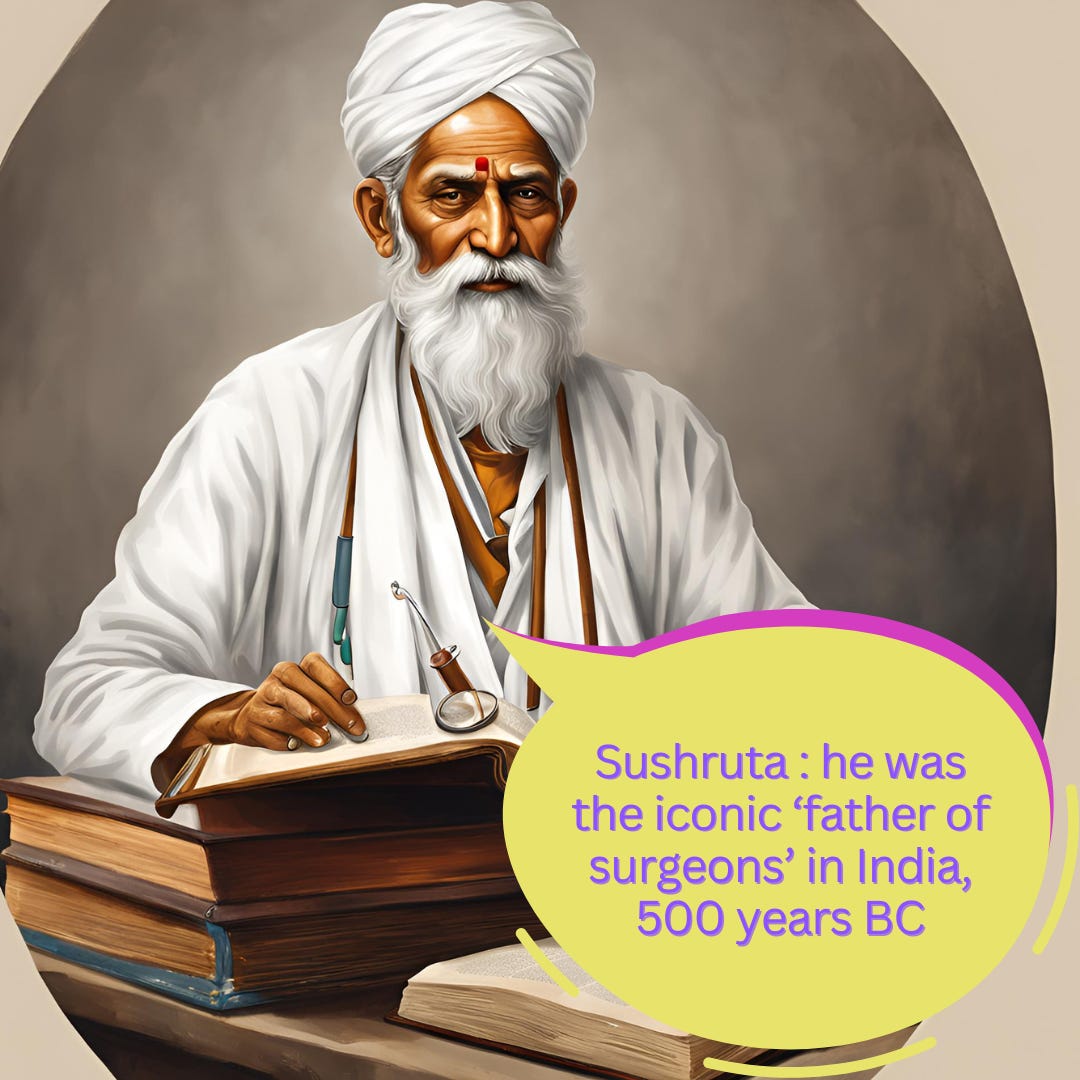
🗣️ If we talk about the history of surgery, we must look at India. Sushruta-Samhita, the textbook of surgery was written by Sushruta. He was the iconic ‘father of surgeons’ in India, 500 years BC.
The wound was closed by the jaws of large black ants, bringing the skin together on both sides. Their jaws are quite strong. So the skin was clinging together. I use a similar technique in modern surgery. Although the jaw of the ant has been replaced by titanium staples.
In this, there is no inflammation in the tissue and wound repair is possible without sutures. Two and a half thousand years ago, Sushruta discovered such a useful healing method.
🤕 Wound healing
👉🏾 In fact, neither the surgeon nor the patient has any control over how the surgical wound heals. When the tissue on both sides of the patient’s wound is brought face to face and placed in front, the collagen of the body forms a bridge between the two sides through various physical reactions. That’s a separate story. Keep it for another day.
The job of the thread is to hold these two tissues together until the body heals, so the body can do its own healing properly. The thread also has another function, which is to prevent bleeding from the blood vessels during the surgery. This type of use of thread is not called stitching, it is called ligature or loop.
🪢 Knot
How to knot a thread is a different science altogether. There are more than two dozen knot tying techniques that we must master over years of surgical training.
🧑🏼🦱 Sir Joseph Lister
The emergence of modern surgery seems to have started in 1870s. When British surgeon Sir Joseph Lister invented sterile surgical practice. Lister’s revolutionary ideas changed the world of surgery. Before that, patients and doctors used any room for surgery, wearing street clothes, without even washing hands. Surgery was done in pubs, temples, in front of the king, everywhere. There is a ward named after the famous Lister in our Calcutta Medical College’s Eden Hospital.

It is said that in 1876, Lister delivered a speech at the Philadelphia Centennial Exhibition’s Medical Congress. One Robert Wood Johnson, inspired by his speech, founded a company called Johnson & Johnson. A company that manufactures surgical equipment. Which is still going strong today, albeit with a changed name.In 1887, Johnson & Johnson brought some new types of yarn to the surgical market. These threads were thouroughly cleaned and kept sterile with spirit.
👉🏾 From the Red Cross to the surgeons, everyone jumped at the chance to pick up this thread. A visit to the old records revealed with the advent of sterile sutures and needles, along with a clean surgery room, clean clothes, the patients recovered faster and returned home earlier.
💉 Needles
Look, I’ve been talking about thread for so long. Almost forgot about surgical needle. Without the needle thread cannot be sewn in the human body. Science inventions are there too. Sharp tools made of stone or bone have been used by humans for thousands of years.
In archaeological remains found 32,000 years ago, we see modern needles stuck in the skulls of Neolithic era fossils. Needles has a place for threading. Eye of the needle.
👉🏾 Mothers, aunts embroidered exotic table cloth using threaded eyed needle. Until now, not only ordinary people, but also surgeons have been using crude needles with eyes. But the body is not a table cloth!
Think of it when this thread goes through the eye of the needle, and it’s stitched through. That stitch passage is three times as wide. Two threads on both sides and a needle in the middle. Takes time to heal. But we found a solution soon.
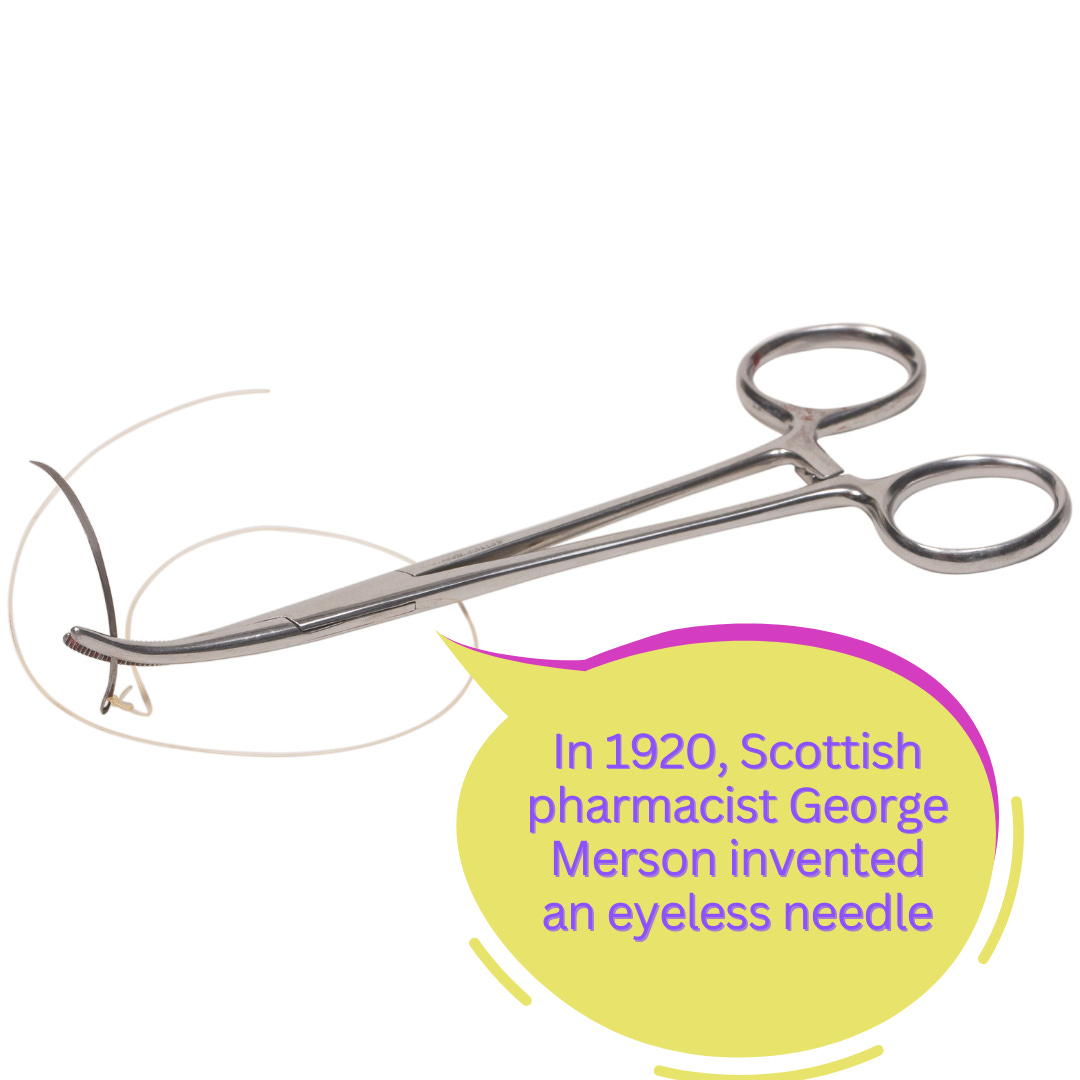
🪡 Atraumatic Needle
👉🏾 In 1920, Scottish pharmacist George Merson invented an eyeless needle. He attached the thread directly to the needle. There was no need to thread the needle. The size of the wound at every bite is reduced to bare minimum. The patients recovered even faster.
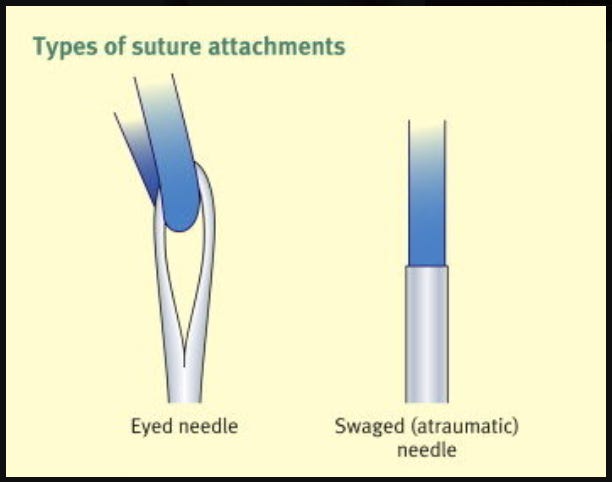
This discovery was groundbreaking. The timing was impeccable. Because a few years after that heart surgery would start. Such surgery needed stitching large blood filled tubes or blood vessels. When surgeon used this atraumatic needle, blood did not leak. Note the name A-TRAUMATIC means trauma-free.
👉🏾 Honoring the name of Merson some stitches still retain the first letters of his name. Mer-silk / Mer-suture.
👉🏾 A few years later Mr. Merson and Mr. Johnson joined hands together and a joint company Ethicon was born. Today, most modern yarns are made in Ethicon’s laboratories.
🧵 Types of threads
In 1969 came the synthetic stitch. These stitches were thin, but very strong. Surgeons’ first choice in heart bypass surgery. The price of this thread was quite high. We need to use such threads in complex gynecology surgeries. The problem is, it is difficult to handle. Five years later, in 1974, another stitch was invented. Called Vicryl. Soft and foldable. This thread is easily absorbed in the human body. No need to remove. Like a braid of hair, the fibers are twisted. Resulting in a very soft thread. Braids can harbor hidden germs. So surgeons had to take various precautions while using them.
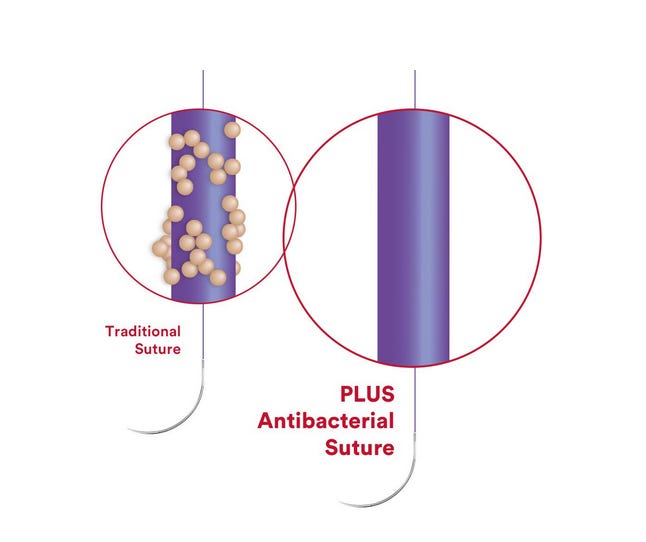
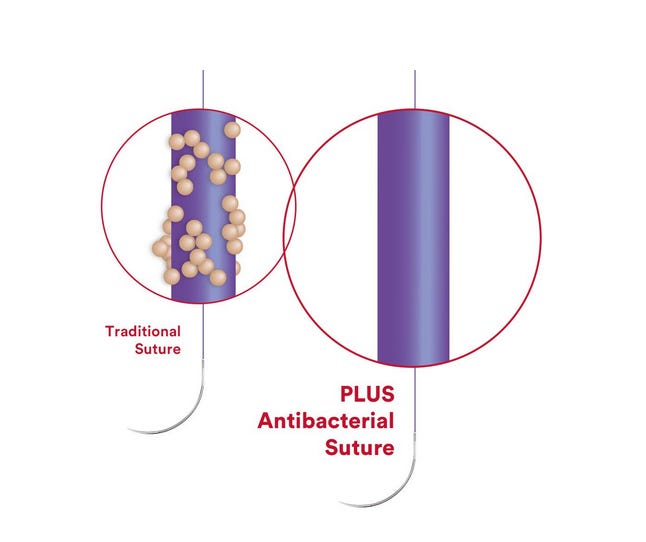
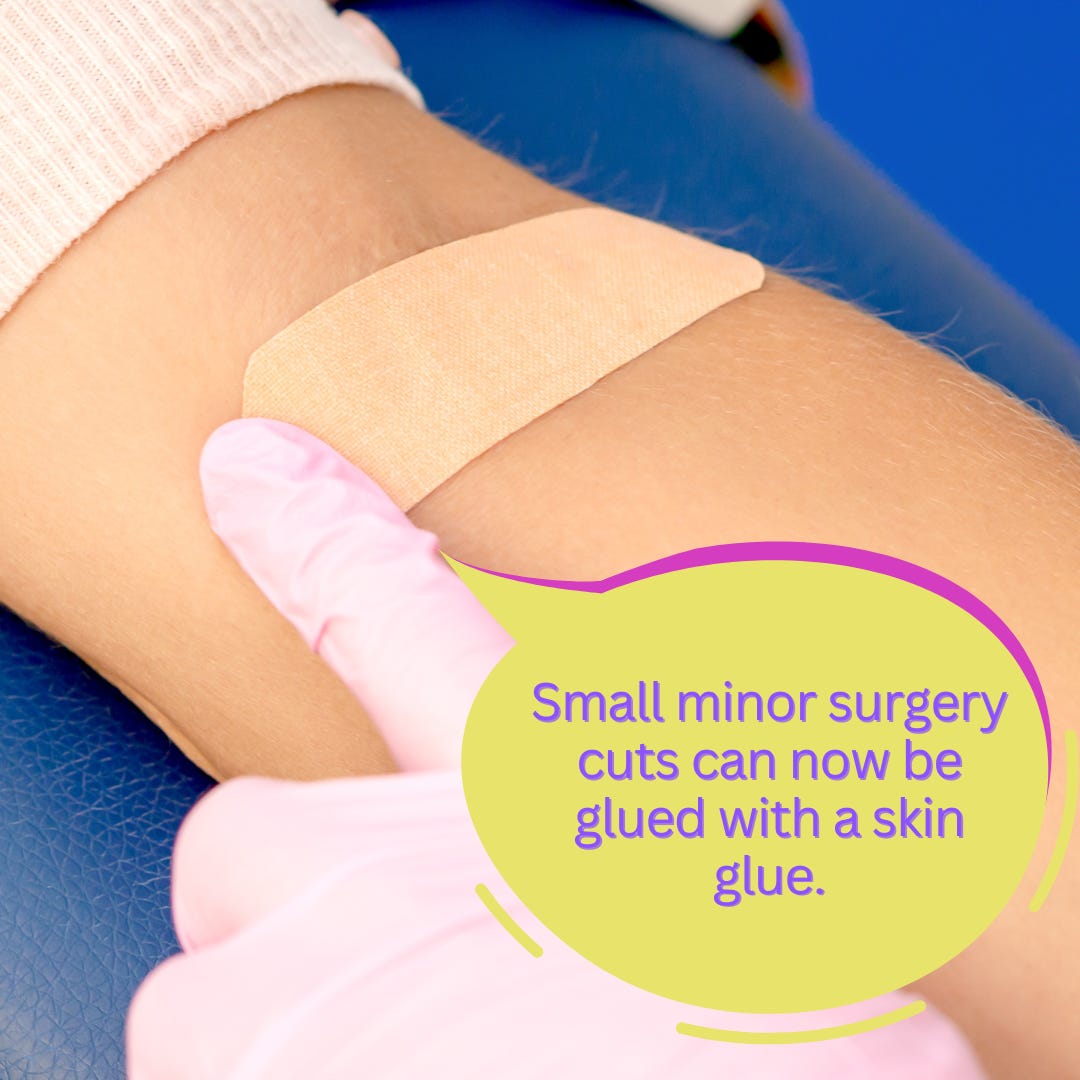
Recently Vicryl has come up with an antibiotic coating, reducing the chance of infections. After that, strong, absorbable stitch PDS came into the market. Then came softer but costlier monocryl, loved by a plastic surgeon for cosmetic reasons. Small minor surgery cuts can now be glued with a skin glue.
Surgeons, like us, pay meticulous attention to the selection of threads and needles for surgery.
The needles used in surgery are not as straight as the needles used in cloth stitching. Because there is no place to move such big needles deep inside the body. Surgical needles are often crescent-shaped to allow movement in a narrow place. They vary in diameter. Some are thin and some strong. Some needles are sharply bent. Some are more straight-ish.
The shape of the patient’s body, the size of her organs, and the depth of the body where the stitching is done determine exactly which needle to use.
Nowadays, needles are being made of sophisticated metal alloys instead of stainless steel. These are thinner but stronger. The sutures cause minimal trauma when used. Patient recovers even faster.

🚥 Caution
Each stitch has a different purpose. It also varies widely in price. The price of a single thread starts from Rs 60 to around Rs 3000. On top of that government takes taxes.
As patients, we often feel delighted when our operation is done cheaply. But do we know what material of stitches are used inside? How many people have access to this information? The side effects of using low-quality stitches often show up after decades. By then, patient might have forgotten about the surgery.
👉🏾 Patients undergoing complex gynecological surgeries often take longer to recover due to low protein levels. At this time, thread selection plays a crucial role. Surgery and suturing are performed differently in cancer patients to enhance healing.
👉🏾 When discussing the cost of treatment with the hospital-doctor, let him know in advance about your concerns about the consumables used. Surgeons like us have to take some responsibility for what kind of thread, what needle and what materials are used inside. Who else will take responsibility and fight for the patient’s interests, in this modern economy?
This is an impartial , unsponsored health information. For public awareness and not a replacement of Medical Advice.
Reference
Snyder CC. On the history of suture. Bull Hist Dent 1977;25:79–84 [PubMed] [Google Scholar]
Breasted JH. The Edwin Smith Papyrus: Hieroglyphic Transliteration, Translation and Commentary. Chicago, IL: University of Chicago Press; 1930 [Google Scholar]
Dawson WR. Making a mummy. J Egypt Archaeol 1927;13:40–9 [Google Scholar]
Ricci JV. The Development of Gynaecological Surgery and Instruments. San Francisco, CA: Norman Publishing; 1990 [Google Scholar]
Scott M. 32,000 years of suture. NATNews 1983;20:15–17 [PubMed] [Google Scholar]
Greive J. Medicine in Eight Books, Translated with critical notes and explanatory. London: D Wilson and T Durham; 1756 [Google Scholar]
Bollom T, Meister K. Surgical principles: biodegradable materials in sports medicine. In: DeLee JC, Drez DJ, Miller MD. eds. DeLee & Drez's Orthopaedic Sports Medicine: Principles and Practice. 2nd edn Philadelphia, PA: Saunders; 2003 [Google Scholar]
Kravetz RE. Horse hair sutures. Am J Gastroenterol 2003;98:691. [PubMed] [Google Scholar]
Gruner OC. A Treatise on the Canon of Medicine of Avicenna, Incorporating a Translation of the First Book. London; Luzac & Co.; 1930 [Google Scholar]
Paré A. OEuvres complètes d'Ambroise Paré. Paris: J-B Baillière; 1840 [Google Scholar]
Edwards G. Philip Syng Physick, 1768–1837. Proc R Soc Med 1940;33:145–8 [PMC free article] [PubMed] [Google Scholar]
Dorsey JS. Elements of Surgery: For the Use of Students. Philadelphia, PA: Parker & Warner; 1818 [Google Scholar]
Truax C. The Mechanics of Surgery. Chicago, IL: Hammond Press; 1899 [Google Scholar]
Search tools: Suture stitch needle surgeon vicryl monocryl knott stitching Marsen Lister Ethicon catgut gladiator Achilles tendon Colosseum